Articles on: Tools & Calculators

Estimating animal weight with the weight calculator

Estimating animal weight with the weight calculator


The weight calculator estimates a large animal's weight from two tape measurements, so you can get a usable number without putting the animal on a livestock scale. You measure two things with a soft tape, and the tool returns an estimated weight in pounds and kilograms.


This is a husbandry tool, for feeding, body-condition tracking, transport planning, and watching whether a young animal is growing. It is an estimate, not a scale reading, so do not use it as a precise weight for anything that needs one, such as medication dosing.


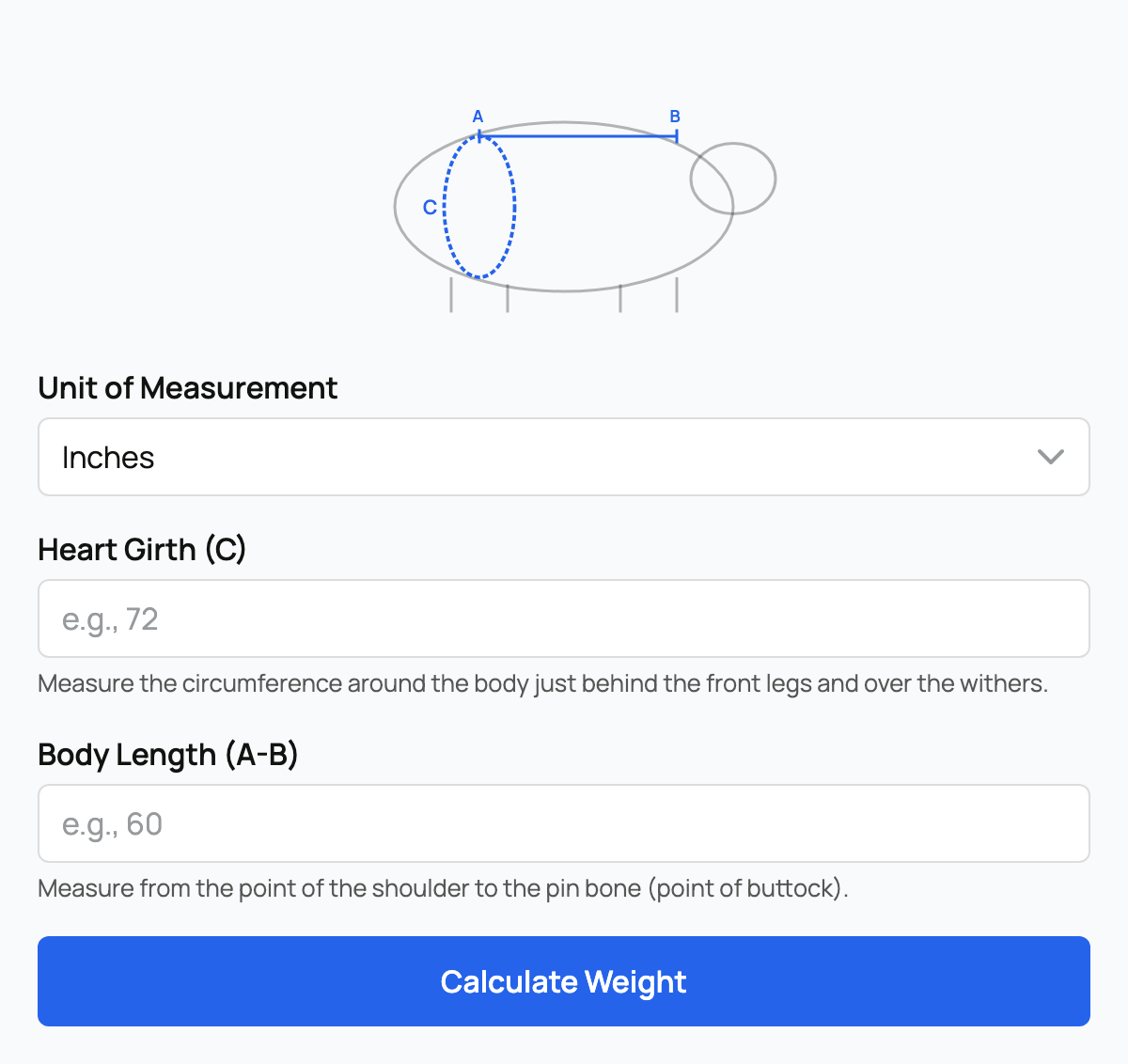
The weight calculator form: unit, heart girth, body length, and the diagram


Finding it (and the species it supports)


The calculator supports ten species: Highland Cattle, Cattle, Sheep, Goat, Horse, Pony, Donkey, Alpaca, Llama, and Pig. Each species has its own page at /tools/weight_calculator?species={species}, for example ?species=cattle or ?species=horse. The page header, the diagram, the measuring tips, and the typical-range table are all specific to the species you chose.


One honest note: the address some pages advertise as the "canonical" weight URL does not currently work, so use the ?species= link above. It is the working route.


The inputs, one by one


  • Unit of Measurement. A dropdown: Inches or Centimeters. This is the unit you measured in. Pick it before you type your numbers. If you measure in centimeters, the result page also shows the inch equivalents it converted to.
  • Heart Girth (C). A number, marked "C" on the diagram. This is the circumference all the way around the animal's body, just behind the front legs, over the highest point of the back. The on-page help text gives the exact landmark for your species. Girth matters most: it is the single biggest driver of the estimate, because the formula squares it. For woolly or long-coated animals (sheep, alpaca, llama, Highland cattle) the tips say to compress the coat or fleece, or measure after shearing, because fluff inflates the girth and therefore the estimate.
  • Body Length (A to B). A number, marked "A to B" on the diagram. This is the straight-line length from the point of the shoulder to the point of the rump (the pin bone), per the on-page help. It scales the girth-based estimate to the animal's frame.
  • A validation guard. Both measurements must be positive numbers, and anything over 500 (in either unit) is rejected with "Measurement seems too large. Please check your value." So a slipped digit like 7200 is caught rather than producing a nonsense weight.
  • Calculate Weight. The submit button. The result appears below the form.


The output


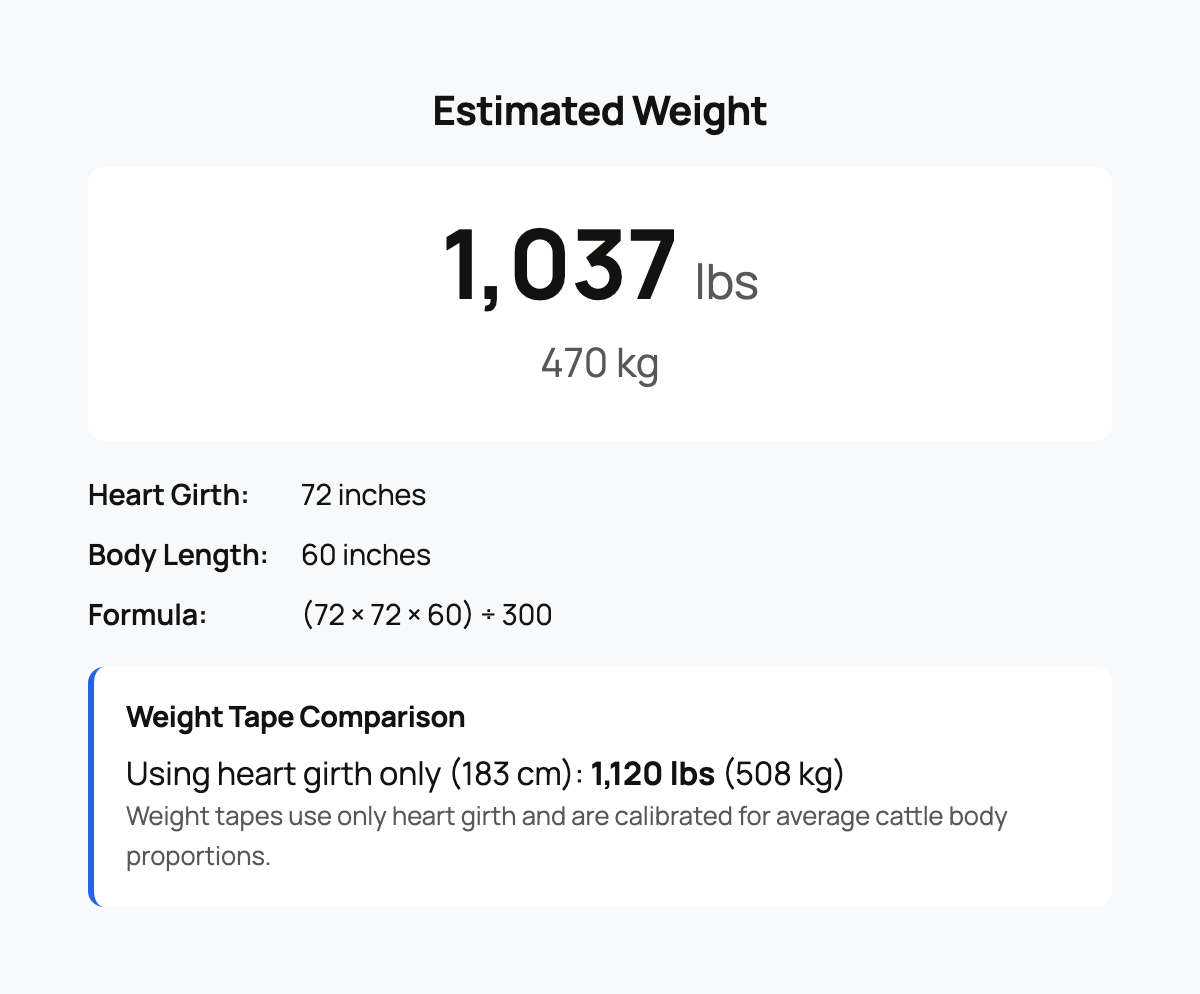
The weight result: pounds and kilograms, the formula, and the weight-tape comparison


  • The weight. A large pounds figure with the kilograms equivalent underneath. You always get both; the tool converts with the standard factor of 0.453592 kilograms per pound.
  • The Formula line. The tool shows the actual arithmetic it used: (heart girth times heart girth times body length) divided by a divisor, with the species' divisor filled in. This is the long-established "girth squared, times length, over a constant" tape formula. The divisor changes with body type: it is 300 for cattle, sheep, goats, donkeys, and the camelids (alpaca and llama), 330 for horses and ponies, and 400 for pigs (which carry their weight differently). You do not work this out yourself; the tool does, and it shows the math for transparency.
  • Weight Tape Comparison (cattle and Highland cattle only). For cattle, the page adds a second estimate calculated from heart girth alone, which is how a printed weigh-tape works, shown next to the two-measurement estimate so you can sanity-check one against the other. The page notes that weight tapes are calibrated for average cattle proportions, so the girth-plus-length estimate is generally the more precise of the two.
  • Measurement Tips and Typical Weight Ranges. Rounding out the page are tips for taking a good measurement and a per-species table of normal ranges (for example cow, bull, and calf), which is a quick way to judge whether your result is plausible.


The disclaimer (read this first)


The tool states it plainly, and so should you: this calculator provides an estimate only. Actual weight may vary by 5 to 10 percent depending on body condition, breed characteristics, and how accurately you measured. Treat the number as a good working estimate for husbandry, and use a real scale when an exact weight matters.


Where to go next


Updated on: 23/06/2026

Was this article helpful?

Share your feedback

Cancel

Thank you!