Articles on: Tools & Calculators

Check market prices with the Livestock Value Calculator

Check market prices with the Livestock Value Calculator


The Livestock Value Calculator at /tools/livestock-value-calculator answers a question every buyer and seller circles around: "roughly what does an animal like this sell for?" You enter the basics (species, breed, sex, and age), and it returns a directional market range built from real auction sales. It is free, public, and works signed out, and it saves nothing to your account.


Two honest framings before the details:


  • It is a market read, not an appraisal. The range describes what comparable animals sold for; it is not adjusted for photos, pedigree, region, training, genetics, or condition, and it is not a valuation of any specific animal.
  • It is stats, not listings. The numbers come from recorded auction sales, so a range only appears when there is enough real data behind it. That is the 25-sale rule below.


Where the numbers come from


The ranges are computed from Creatures' database of catalog-ready auction sales: completed sales of live animals, sold by the head, from real auction results. Only species with enough qualifying sales appear in the species menu at all, so if your species is not listed, it means there is not yet enough sales data to publish a trustworthy range for it, not that you mistyped.


The inputs, one by one


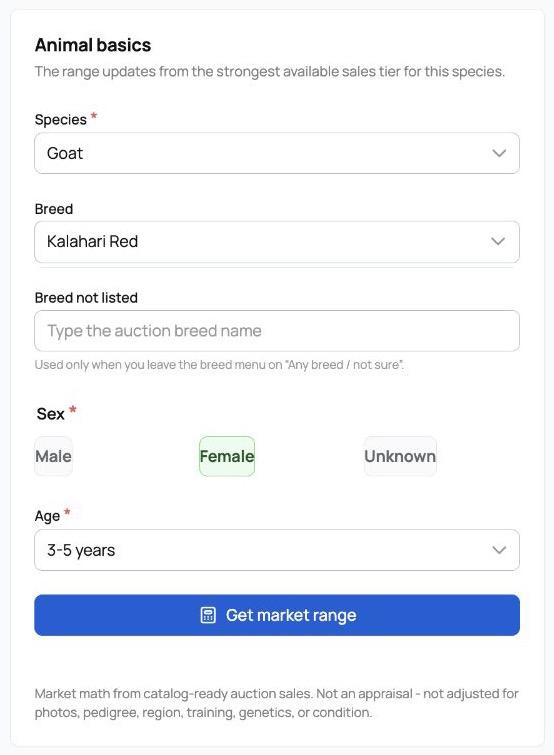
The Animal basics form: species, breed, sex, and age


  • Species. Required. The menu lists only the species with enough auction sales to publish ranges.
  • Breed. Optional. A searchable menu of breeds for the species you picked; it stays on "Any breed / not sure" if you skip it, and that is a perfectly good answer. A species-wide range is still a useful read.
  • Breed not listed. Optional. A free-text box for a breed name the menu does not have; type the name the way an auction catalog would print it. It is used only while the breed menu is on "Any breed / not sure", so pick one route or the other.
  • Sex. Required. Three buttons: Male, Female, or Unknown.
  • Age. Required. Four brackets: Under 1 year, 1-2 years, 3-5 years, or 6+ years. Brackets, not exact ages, because that is how sale data groups.
  • Get market range. The submit button; the result card fills in beside the form.


One practical limit: the calculator allows 30 range checks per hour. Past that it answers "Too many requests! Please try again later.", so give it a breather and come back.


The 25-sale rule (and the labeled fallback)


The calculator never shows a range built on thin air: a range publishes only when at least 25 matching sales back it. To get you the most specific number it can honestly support, it tries three tiers in order:


  1. Exact: your breed, sex, and age bracket together.
  2. Breed-wide: all sales of your breed, any sex or age.
  3. Species-wide: all sales of the species.


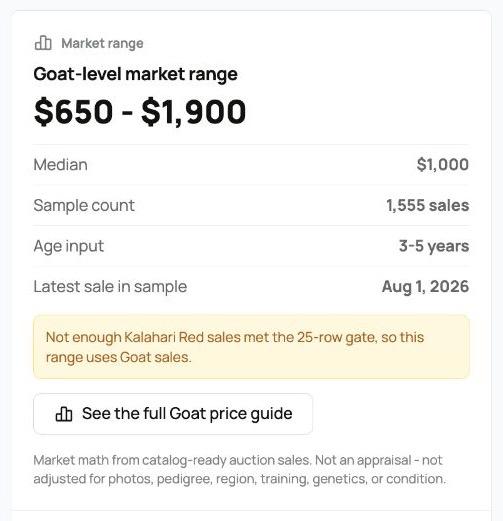
The first tier with 25 or more priced sales is the one you see, and the card always says which one you got. If the exact combination fell short, a highlighted note spells it out, for example that not enough breed + sex + age sales met the 25-row gate, so the range uses all sales of that breed instead, and the heading itself is labeled, such as "Highland-level market range (not adjusted for sex/age)". If even the species-wide tier cannot reach 25 sales, you get "Not enough sales data yet" rather than a made-up number.


The labeled fallback note under a broader-tier range


Reading the result card


The market range card with its range, median, and sample facts


  • The range. The big dollar figure, such as "$1,200 - $3,400", is the middle half of matching sales: from the 25th to the 75th percentile. A quarter of sales landed below it and a quarter above it, so think of it as where the market usually lands, not the floor or the ceiling.
  • Median. The middle sale price, the single most representative number in the range.
  • Sample count. How many sales the range is built on. More sales, steadier range.
  • Age input. The age bracket the range reflects, echoed back so you can confirm what you asked.
  • Latest sale in sample. The date of the newest sale in the data, your freshness check.
  • The caveat line. The card repeats it on every result: market math from catalog-ready auction sales, not an appraisal, and not adjusted for photos, pedigree, region, training, genetics, or condition.
  • A price-guide link. When Creatures publishes a full market price guide for your breed or species, a button under the facts ("See the full ... price guide") takes you to it for the longer view behind the range.


Turning the range into an animal profile


The range is most useful attached to a real animal, so the card ends with a hand-off:


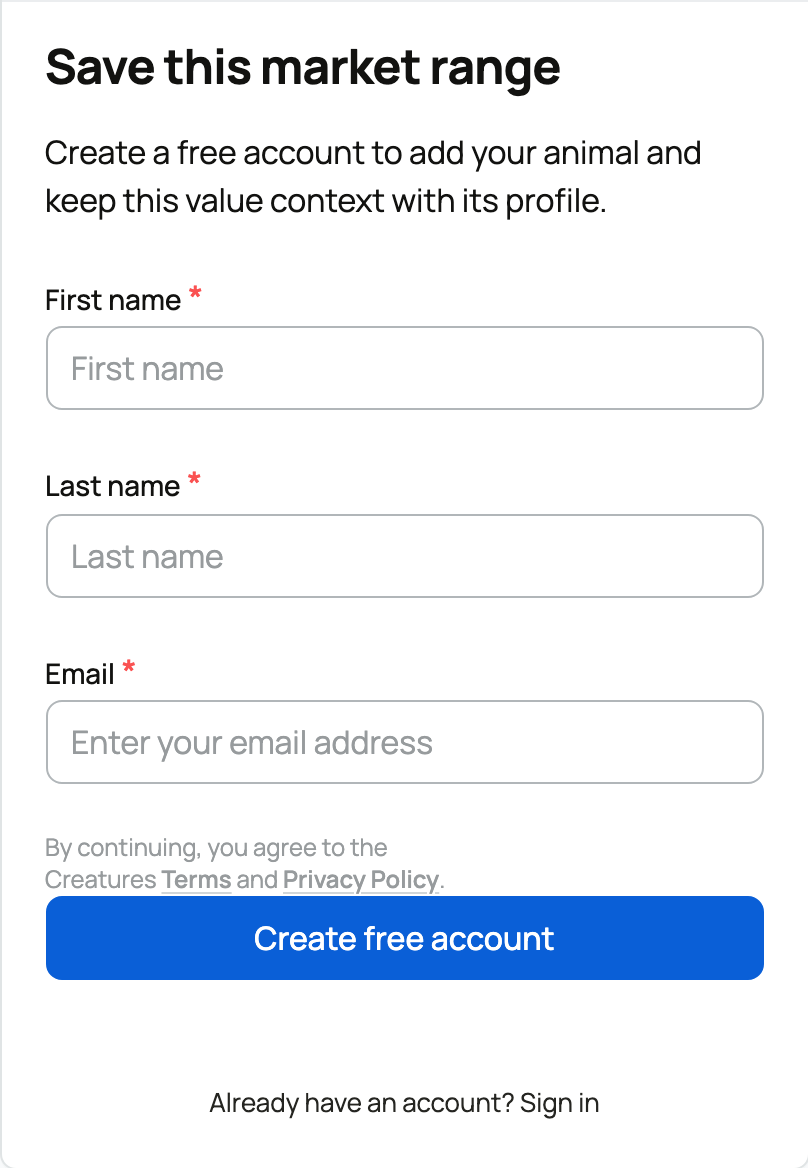
  • Signed out, you get "Save this market range": a short form (first name, last name, email) that creates a free account and keeps the range context ready for the animal you then add.


The guest Save this market range form


  • Signed in, you get "Add animal with these details": one click opens the add-animal form with the species, breed, and sex you entered already filled in, so the animal you just priced is the animal you create. The full add-animal flow is covered in Adding an animal to Creatures.


The signed-in Add animal with these details button


When you want more than a range: the Crestimate


The public calculator deliberately stops at market statistics. The deeper tool is the Crestimate, the signed-in AI valuation for a specific animal on Creatures: it reads the actual profile, including photos, pedigree, genetics, condition, and records, and produces a per-animal estimate with reasoning, not just a range for animals like yours. When you have added the animal, that is the next step: see What is a Crestimate? and How to generate a Crestimate.


Where to go next


Updated on: 22/07/2026

Was this article helpful?

Share your feedback

Cancel

Thank you!