Articles on: Your Animals & Records

What is a Crestimate?

What is a Crestimate?


A Crestimate is an automated, data-driven estimate of an animal's market value that sits right on the animal's profile. It is a starting point for thinking about price and planning, not a formal valuation. The product says it plainly, and so do we:


The Crestimate is an automated, data-driven estimate of an animal's market value. It is not an appraisal and should be treated as a directional benchmark, not a quote.


That sentence is the whole idea. A Crestimate gives you a number to orient around. It is not an appraisal, not an offer, not a recommendation, and not a guarantee of what an animal will sell for. Use it to get your bearings on pricing, never as a fixed value or a figure to quote a buyer as fact.


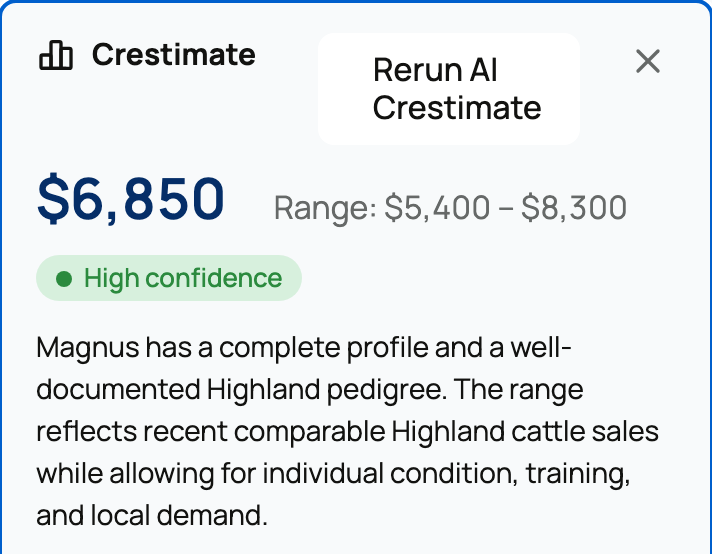
A completed Crestimate on an animal profile


What goes into a Crestimate


The estimate is built from what is on the animal's profile, plus market data:


  • The core profile facts: species, breed, sex, age, and location. These are the backbone of the estimate.
  • Recent comparable sales: real sales of similar animals from public auction data over roughly the last twelve months. These ground the number in what comparable animals actually fetched.
  • Optional context that sharpens it: a pedigree (sire and dam), color, conformation photos on the profile, and a written profile description. The more of this you fill in, the more the estimate has to work with.


What this means for you: a Crestimate is only as good as the profile behind it. A bare profile with the minimum facts produces a wide, low-confidence range. A complete profile, with a pedigree, photos, and a description, produces a tighter, more confident estimate. The estimate rewards a well-kept profile.


How a Crestimate is made


Creatures does not lean on a single opinion. Several independent valuation models analyze the inputs at the same time, and then a senior reviewer model cross-checks and reconciles them into one result: a single best-estimate figure, a range, and a confidence rating.


How the Crestimate works, with the inputs, the confidence ratings, and the privacy note


You can open this explanation any time from the "Learn how Crestimate works" link on the panel. It lays out what goes in, how the estimate is made, what each confidence rating means, the privacy rules, and the fine print, all in one place.


What this means for you: the range you see reflects genuine disagreement between the models, not rounding. When the models broadly agree and there are plenty of comparable sales, the range is tight and the confidence is high. When the data is thin or the models disagree, the range widens and the confidence drops. The range is honest about how sure the system actually is.


The two numbers: pinpoint and range


Every Crestimate gives you two figures, and they answer different questions:


  • The pinpoint is the single best-estimate dollar figure, the system's one-number answer.
  • The range (a low and a high) is where the value most likely sits.


What this means for you: when confidence is high, the pinpoint is trustworthy and you can anchor near it. As confidence falls, the range widens and the pinpoint matters less. Below high confidence, treat the range as the real answer and the pinpoint as a midpoint. Quote yourself the range internally, not the single number.


The four confidence ratings


The confidence rating is computed by Creatures, not claimed by a model. It blends how much the models agreed, how many close comparable sales there were, and how complete the profile is. You will see one of four labels, shown as a colored dot and a word:


  • High: strong agreement across the models, backed by ample comparable sales. The pinpoint is the most trustworthy here. It is safe to anchor your pricing near it.
  • Moderate: reasonable agreement, but some inputs are missing or comparable sales are sparse. Lean on the range, and treat the pinpoint as a midpoint rather than a precise figure.
  • Low: limited data, a wide range, or real disagreement between the models. Treat it as directional only. Fill in the optional fields (see below) and refresh before you rely on it.
  • Insufficient: there is not enough data for a reliable valuation, so the number is a general-market guess only. At this level the panel shows a footnote saying so, and the public summary hides the pinpoint entirely (more on that in Showing a Crestimate and using it for pricing). The exact footnote you will see reads:


Our data isn't yet sufficient to offer an accurate valuation with confidence. This estimate is based on general market knowledge and should be used directionally only.


What this means for you: the rating tells you how much weight to put on the number. High means anchor near it; insufficient means treat it as a rough hint and improve the profile. To learn how to raise the confidence on a specific animal, see How to generate a Crestimate.


Who can see a Crestimate


The full Crestimate, with its reasoning and the comparable sales behind it, is private:


The full Crestimate (including reasoning and comparable sales) is only ever visible to the animal's owners and team. Non-owners only see a compact summary, and only if you choose to display it.


So your reasoning and the details of how the number was reached stay private to you and your team. A buyer browsing the profile sees nothing unless you turn on a public summary, and even then they see only a compact version. How that public summary works, and how to use a Crestimate to price a listing, is covered in Showing a Crestimate and using it for pricing.


The honest fine print


To set expectations cleanly, the product states its limits directly, and we will repeat them here word for word:


Crestimate is provided as-is, without warranty. It does not constitute an offer, recommendation, or appraisal.


A Crestimate is a helpful, data-backed signal to inform your own judgment. It is a tool, not a promise. Treat it as one input among several, alongside your own knowledge of the animal and the market. When you are ready to put it to work, it is a natural starting point for listing an animal at a fixed price.


Updated on: 23/06/2026

Was this article helpful?

Share your feedback

Cancel

Thank you!