Articles on: Breeding & Genetics

Using the gestation calculator

Using the gestation calculator


The gestation calculator estimates a due date and a likely window from a breeding date, tuned to the species you choose. It is a quick planning tool and does not require recording a breeding first. This guide explains every input, every cattle refinement, and how to read the result.


Find the calculator


Open the Tools page and choose the calculator for your species, for example the cattle gestation calculator. Creatures has calculators for cattle (and Highland cattle), horses, ponies, donkeys, dogs, cats, goats, sheep, pigs, alpacas, llamas, rabbits, ferrets, guinea pigs, hamsters, gerbils, mice, and rats, each with its own gestation average and natural range.


The gestation calculator


Enter the breeding details


These inputs are available for every species:


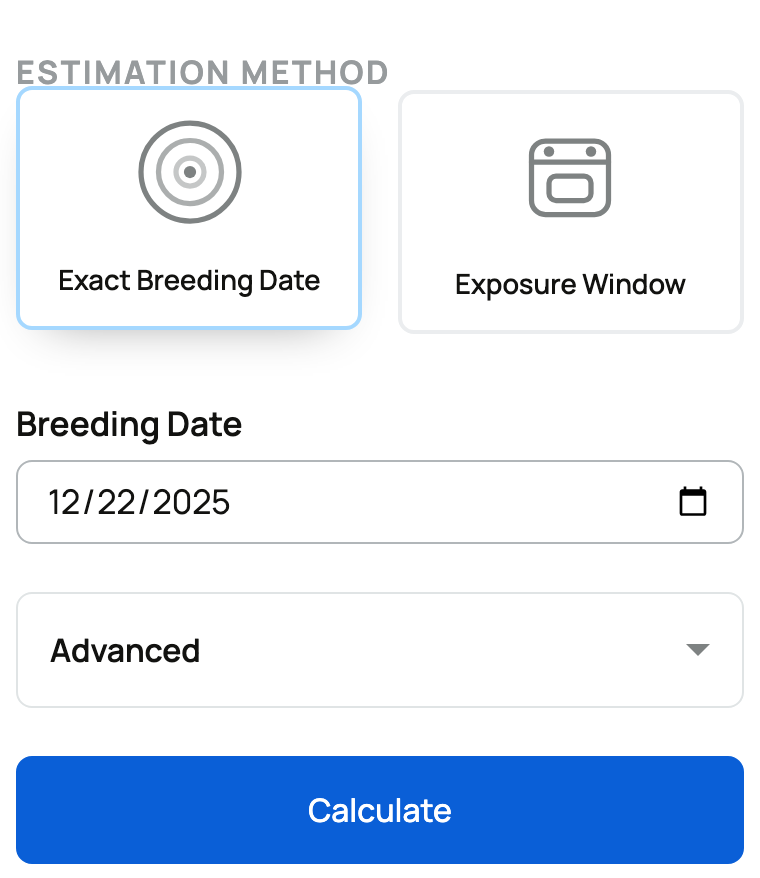
Breeding date, or an exposure window


Most species let you choose how you know the breeding date:


  • A single breeding date is the exact mating, AI, or transfer date. Choose this when you know the day.
  • An exposure window is a turn-in and a pull-out date, for a male that ran with the female for a stretch (this option appears for species where it makes sense, like cattle and horses). The calculator assumes conception at the midpoint of the window, so the wider the window, the less precise the result.


The date has to fall within roughly two years past and three years out, which keeps the result sensible.


Gestation length


Gestation length defaults to the species average (cattle 283 days, dogs 63, horses 340, goats 150, pigs 114, and so on). You can override it with your own number if you have herd data that differs. Overriding it shifts the whole projection by the difference, so only change it if you know your animals run longer or shorter than the breed average.


Cattle refinements


Cattle (and Highland cattle, which inherits them) offer extra refinements that nudge the estimate. Each is optional, and leaving one unset simply skips that adjustment:


  • Breed. Each cattle breed carries its own average, so picking one replaces the generic 283 days: Angus 283, Hereford 285, Charolais 286, Limousin 288, Simmental 287, Holstein 279, Jersey 281, Brahman 292, and Highland 280. The implication is a tighter estimate for your breed rather than a species-wide guess.
  • Fetal sex. A male calf adds about a day, twins subtract about four days, and a female is the baseline (no change). It is a small adjustment, useful when an ultrasound already told you the sex.
  • Parity. A first-calf heifer tends to run about a day shorter than a mature cow, which is the baseline. Choose the one that fits the dam.
  • Embryo transfer. If this is a transfer, picking the embryo's age at transfer (day 6, day 7, or day back-dates the conception by that many days, because the embryo had already been developing. Day 7, for example, counts conception as seven days before the transfer date.
  • Pregnancy check (back-calculation). Instead of a breeding date, you can enter a pregnancy-check date plus the estimated fetal age in days and let the calculator work backward to the breeding date. The check method you pick is recorded for reference: ultrasound or a blood test (reliable from about 28 to 30 days) or palpation (usually waited on until 40-plus days to protect the pregnancy). The method itself does not change the math; the fetal age you enter does.


Read the result


A calculated result


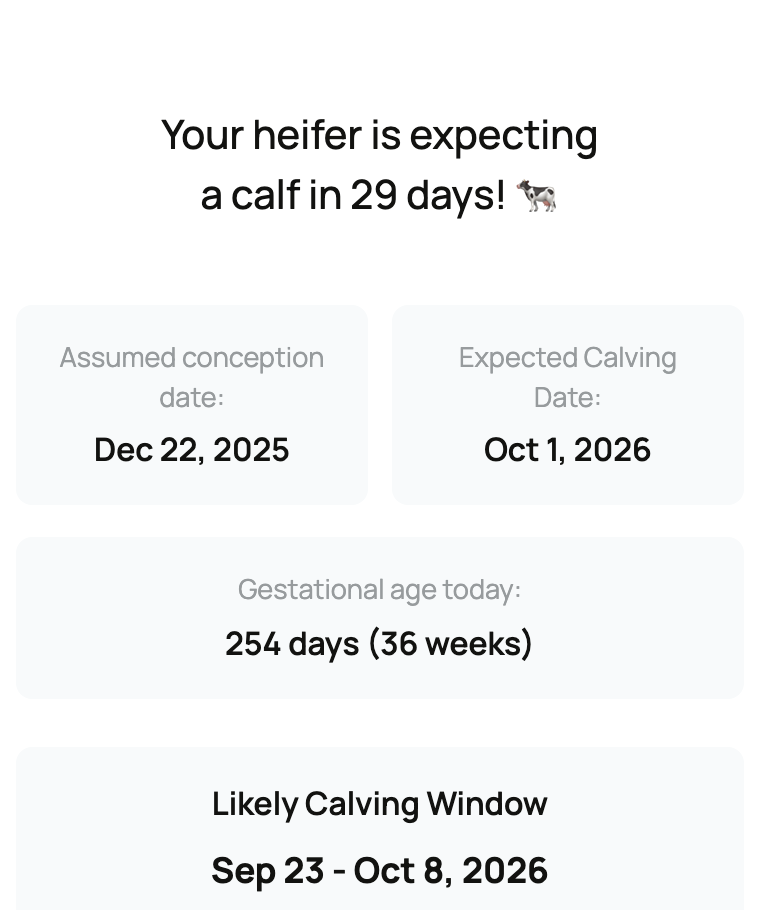
The result gives you:


  • The expected birth date, the calculator's single best estimate.
  • The likely window, the range the birth is likely to fall in (for cattle, roughly 275 to 290 days from breeding; for horses, a much wider 320 to 370, reflecting how variable mares are).
  • How far along the pregnancy is today, and the days remaining, shown once the breeding date has passed.
  • A care timeline of recommended checkpoints for the species. For cattle this includes when a blood test or ultrasound check first becomes reliable (around day 28), when palpation is typically safe (around day 41), and the fetal-sexing window (about days 55 to 70).


Use Add to calendar to export the dates as a calendar (.ics) file. You can export the due date on its own, or any individual care-timeline checkpoint, so the reminders land in whatever calendar you already use. The button is available once a due date has been calculated.


Updated on: 23/06/2026

Was this article helpful?

Share your feedback

Cancel

Thank you!