
Test a mating before you breed: pedigree and COI
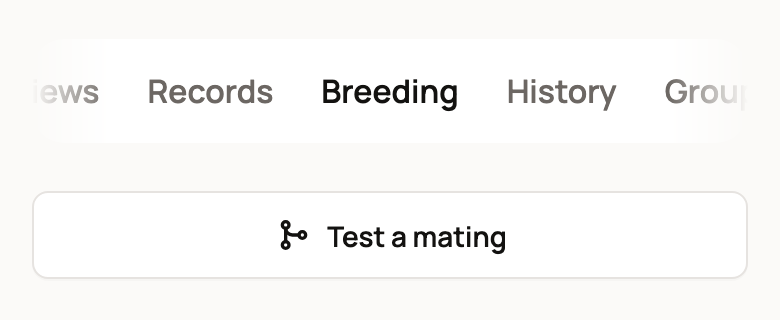
To check how closely two animals are related, open either one's Breeding tab, choose Test a mating and pick the sire and dam. Creatures shows the pedigree their calves would have and their COI, without recording a breeding.
COI (coefficient of inbreeding) is the chance that a calf gets two copies of the same gene from one shared ancestor. A higher number means the parents are more closely related.
Pick a pair
On the animal's Breeding tab, choose Test a mating. Once you save pairs, the button also shows how many. You can also choose Test mating on the Pedigree tab.
Then:
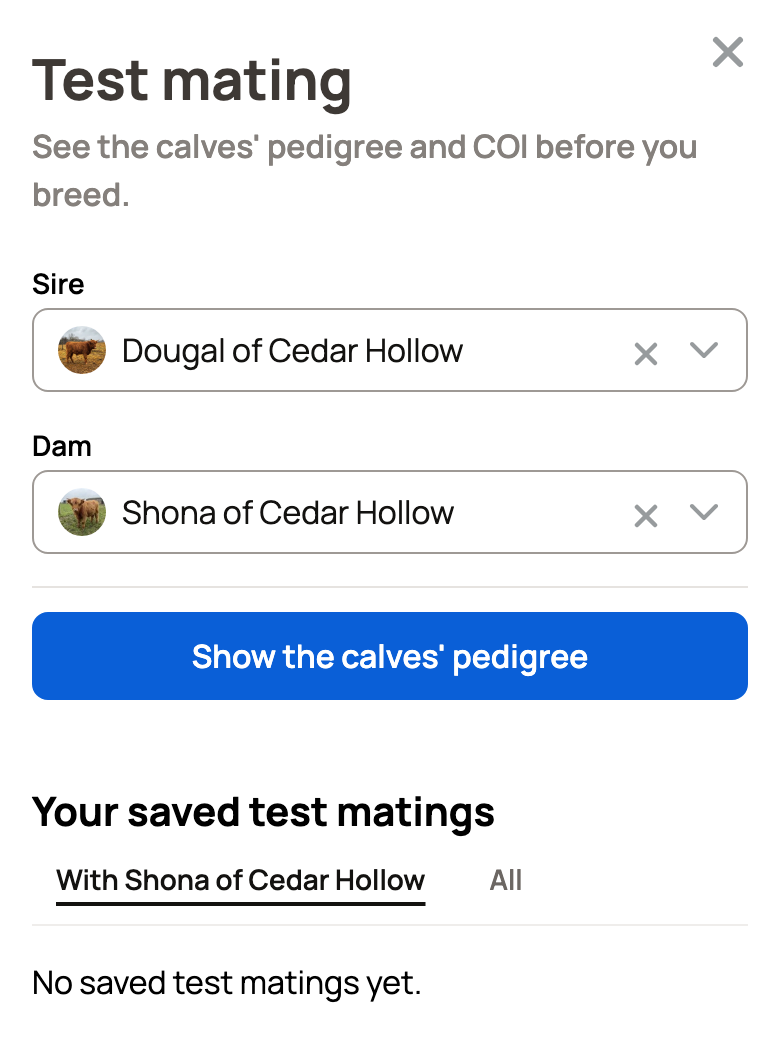
- In Test mating, choose the Sire and the Dam. The animal you started from is already filled in. Both must be the same species, and you must be able to see both pedigrees.
- Choose Show the calves' pedigree. The words follow the species.
Looking at a male offered at stud? On his profile, choose Preview with my female. Pick her under My female, then choose Preview pairing. You see the same projected pedigree and COI, and nothing is recorded or shared. The list shows only females of his species that you own or co-own, and her profile can stay private.
Read the result
The top of the projected pedigree names the pair and shows the COI, such as COI 6.3% over 4 generations. Below it, the tree shows the calves' parents, grandparents and beyond. Choose Change pair (Change on a phone) to try another sire or dam.
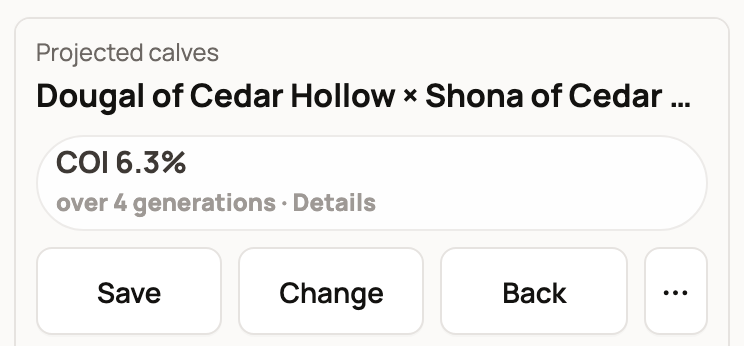
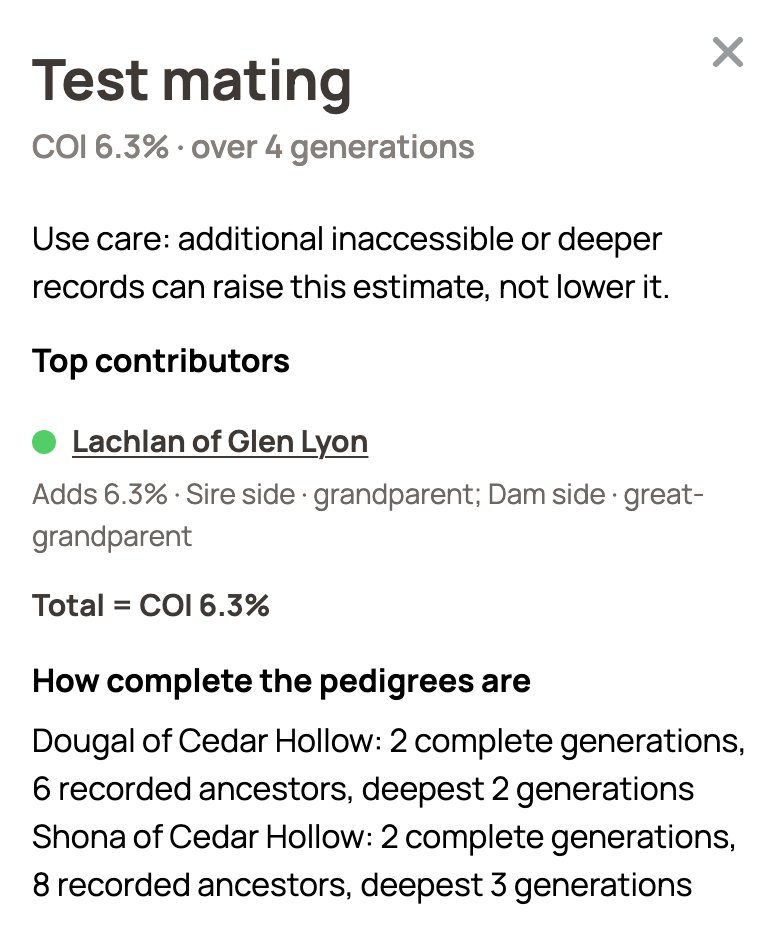
Choose Details to see what's behind the number:
- Top contributors lists each shared ancestor, how much it adds and where it sits. For example, one bull can be the sire's grandparent and the dam's great-grandparent. Own COI shows when that ancestor was inbred too.
- Total adds the contributors up to the COI.
- How complete the pedigrees are shows how many generations are recorded for each parent.
You may see a different result:
- No shared ancestors: none were found in the generations recorded on Creatures.
- Too few recorded ancestors: add older generations to either parent to get a useful number.
- At least a percentage: older generations weren't compared, so the real COI may be higher.
When the pedigree is complete at least five generations back, Creatures adds a label. It's Lower recorded COI under 5%, Moderate line-breeding from 5% up to 12.5%, and Close breeding at 12.5% or more. A COI of 12.5% or more always shows Close breeding, even with older generations missing.
Missing or private ancestors can only hide relatedness. Adding older generations can raise the COI, never lower it.
Guinea pig pairing notices
For guinea pigs, the result can also show a pairing notice about roan or dalmatian colors or satin coats, based on the parents' recorded colors, breeds and parents. It's separate from the COI and links to its guide. No notice doesn't mean a pairing is free of health risks. See Recording a breeding for details.
Save or plan the pairing
- Save keeps the pair under Your saved test matings, with a tab for this animal and one for All. From a saved pair's menu, choose Rename / note or Remove.
- Plan this pairing starts a public page for the planned calves. Nothing is public until you publish it. You'll find it in Details, or in the ⋯ menu beside Save, when it's available. See Share offspring updates on a public page.
- If the parents have published genetic evaluations, such as EPDs, the result lists each parent's reported values side by side. Creatures doesn't calculate an estimate for the calves. See Record EPDs and other genetic evaluations.
A test mating never records a breeding. When you breed the pair, record the breeding so Creatures can track her due date.
Related information
- Pedigree, family, and lineage
- Reference animals: documenting lineage and inviting the owner
- Recording a breeding
- Share offspring updates on a public page
Updated on: 29/10/2026
Thank you!